

Huge thanks to this month’s donor, who wishes to remain anonymous but has asked me to post a link to this poem by their friend, Arthur L Wood. I’m no great shakes when it comes to literary criticism but I was moved by its tenderness and honesty, and heartily recommend giving it a listen.
 “2025 was one of the Three Hottest Years on Record, Scientists Say… despite the presence of a La Nina…
“It was also the first time that the three-year temperature average broke through the threshold set in the 2015 Paris Agreement of limiting warming to no more than 1.5 degrees Celsius (2.7 Fahrenheit) since preindustrial times.”
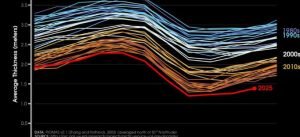 “The thickness of Arctic sea ice dropped to a new all-time record low this year around the North Pole (data from PIOMAS).
“More in my latest ‘climate viz of the month’ blog: [Zack Labe]
https://zacklabe.com/climate-viz-of-the-month/
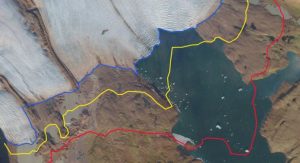 “Iceland’s glaciers play an important role in regulating freshwater resources in Europe.
“This Image Of The Day by a CopernicusEU Sentinel-2 (11 Nov), shows the Breiðamerkurjökull.
“Over the past 25 years its terminus has retreated by 6 km.”
https://x.com/CopernicusEU/status/2005194523790721506
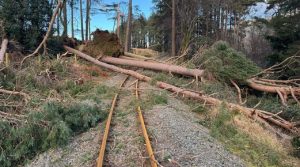 “Dramatic photos show impact of storms, drought and landslides on famous North Wales railway.
“Heritage railways in North Wales are facing mounting impacts from climate change. This year the Ffestiniog & Welsh Highland Railways (F&WHR) celebrated its 70th anniversary with a succession of weather-related challenges.”
https://www.dailypost.co.uk/news/north-wales-news/dramatic-photos-show-impact-storms-33136343
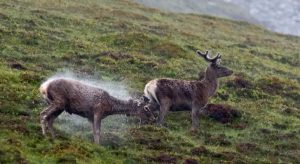 “Extreme weather events are ‘new normal’ for UK wildlife.
“With 2025 on track to be the warmest year on record, the charity said the country’s landscapes and wildlife had been strained… “The compound impact is year after year of these extreme weather events is just exacerbating the pressures and stresses on the natural world,” said Ben McCarthy, the trust’s head of nature conservation.”
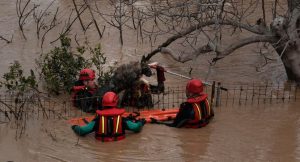 “Roads turn into rivers on the Costa del Sol: Flood-hit Spain issues rare ‘red weather alert’ warning…
“Vehicles can be seen bobbing through the murky waters as the strong currents swirl around them, leaving tourists and locals trapped in their buildings. Authorities said floodwaters at some places were ‘several meters in height’.”
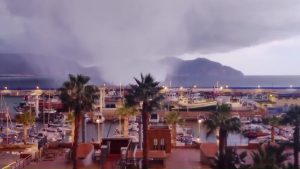 “Three waterspouts caused extensive destruction in the port of Mazarron on Sunday, December 28, as storms hit Spain’s eastern coast.
“The triple waterspout can be seen in this video recorded by Iban Moreno. “It’s hailing, and there are tornadoes on the coast,” Moreno is heard saying.”
https://www.yahoo.com/news/videos/three-menacing-waterspouts-swirl-off-010745481.html
 “Great white sharks face extinction in Mediterranean, say researchers…
“This is according to research by US scientists, working in partnership with UK charity Blue Marine Foundation, external. They say some of the most threatened species – including great white sharks – are being sold in North African fish markets.”
https://www.bbc.co.uk/news/articles/c9qe9wvq534o
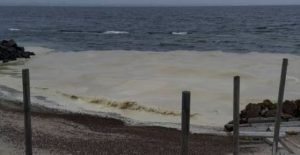 “Sunflower oil pollution could persist at the bottom of the Black Sea for more than 6 years…
“Following Russian attacks on December 20th on sunflower oil storage facilities at the port of Pivdenny near Odesa, tanks were damaged, triggering significant and potentially damaging marine pollution. Witnesses reported that the vegetable oil quickly covered neighboring areas, and soon reached the Adzhalik estuary.”
 “EXTRAORDINARY, HISTORIC – records pulverized all over Africa:
“40.6 [105.1F] Garoua – CAMEROON HOTTEST DECEMBER DAY IN HISTORY; 40C in Ghana, Chad, Niger, Nigeria… KENYA has also broken records everywhere this month: coast, plains and highlands. Today 38.1C Garissa.”
https://x.com/extremetemps/status/2005710792696762720
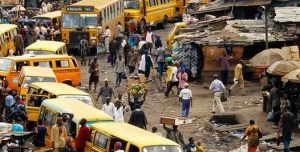 “Why Nigeria needs a national heat management plan.
“During the 2025 Ramadan fasting period, schools were shut in some states across northern Nigeria. The decision sparked public outrage, with many Nigerians questioning it. The unanimous reason given by authorities was that the heat had become unbearable…”
https://www.thecable.ng/why-nigeria-needs-a-national-heat-management-plan/
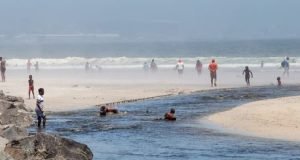 “Cape Town is currently experiencing an intense heatwave, with temperatures soaring across the city as residents and tourists cope with the scorching sun…
“The unusual spike in temperatures comes amid a broader pattern of extreme weather across South Africa, highlighting the growing impact of climate change on local weather patterns.”
https://sierraexpressmedia.com/sun-soaked-cape-town-heatwave-conditions/
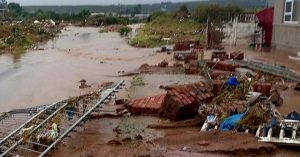 “Over 150 homes destroyed as disaster teams respond to South Africa’s KwaZulu-Natal floods.
“Disaster management teams have been deployed across several parts of KwaZulu-Natal following severe flooding that has left widespread destruction in both inland and coastal areas, the provincial Department of Cooperative Governance and Traditional Affairs (COGTA) has confirmed.”
https://www.trtafrika.com/english/article/72e7ef2ca9a7
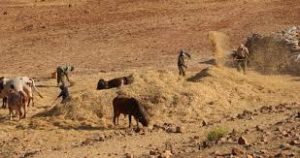 “Historic dry rainy season triggers alarm for deepening food insecurity in the Horn of Africa.
“The unfolding drought is severely undermining local agricultural productivity, less than three years after the historic drought that struck the region from late 2020 to early 2023. FEWS NET estimates 20-25 million people across Somalia, Ethiopia, and Kenya are in need of humanitarian food assistance, with drought the main driver for 50-55 percent of those in need.”
https://fews.net/east-africa/alert/december-2025-0
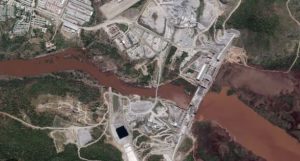 “Egypt says will respond to any harm from Nile dam in Ethiopia.
“His remarks come while Egypt has been objecting to Ethiopia’s unilateral measures on its Grand Ethiopian Renaissance Dam… Egypt, which relies on the Nile for 98% of its renewable water resources, has warned that it will not accept any infringement on, or relinquishment of, a single drop of its Nile water share.”
https://www.egypttoday.com/Article/1/144184/Egypt-says-will-respond-to-any-harm-from-Nile-dam
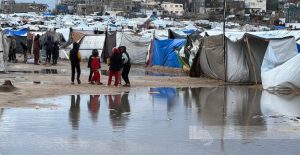 “A Palestinian woman in Gaza has died as a winter storm threatens the lives of nearly 900,000 Palestinians living in tents across the devastated coastal enclave.
“The 30-year-old, identified as Alaa Marwan Juha, died on Sunday when a wall collapsed onto her tent in the Remal neighbourhood to the west of Gaza City, Al Jazeera Arabic reported.”
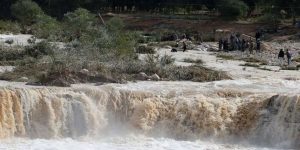 “Jordan: Ministry warns of ‘imminent’ overflow at Wadi Shueib Dam…
“In a statement, the authority urged residents, farmers, and communities living downstream of the dam to take necessary precautions and follow the instructions of relevant authorities… He also warned of the risk of flash floods in valleys and low-lying areas…”
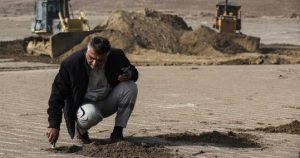 “Iraq battles blowing sand as ‘300 dust days’ loom by 2050.
“Deep in Iraq’s southern desert, bulldozers and earthmovers spread layers of moist clay over sand dunes as part of a broader effort to fight increasingly frequent sandstorms. Iraq has long suffered from sand and dust storms, but in recent years they have become more frequent and intense…”
https://newswav.com/article/iraq-battles-blowing-sand-as-300-dust-days-loom-by-2050-A2512_HtkOpa
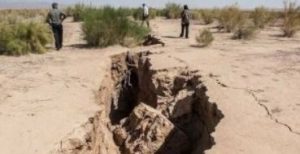 “Restoring Iran’s Zagros soils needs half of annual oil income, official warns.
“Iran is losing soil faster than any other country, and restoring fertility in its vast Zagros mountain range would require diverting roughly half of annual oil revenues each year, a senior forestry expert said.”
https://www.iranintl.com/en/202512284967
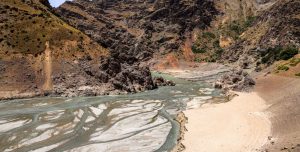 “Tehran at risk: The looming water catastrophe…
“The water scarcity crisis in Iran has developed into a security threat that threatens to disrupt environmental stability, economic productivity, social unity and political stability. The fast depletion of water sources has forced numerous rural communities to leave their homes, while major urban areas face recurring water service interruptions.”
https://www.dailysabah.com/opinion/op-ed/tehran-at-risk-the-looming-water-catastrophe
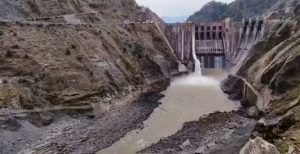 “India’s Chenab dam plan riles eco-activists, Pakistan alike.
“Indian govt forging ahead with several hydro projects in Indus basin after unilaterally suspending treaty. Water weaponisation in climate change-prone region ‘neither sane nor acceptable’, warns Sherry Rehman.”
https://www.dawn.com/news/1964051
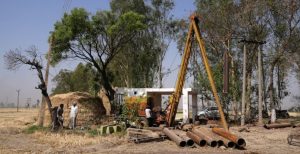 “India’s domination of global rice trade stokes looming water crisis…
“Interviews with growers, government officials and farm scientists, as well as a review of groundwater data, reveal widespread concern that thirsty rice crops are unsustainably draining India’s already-low aquifers, forcing farmers to borrow heavily to drill ever-deeper borewells.”
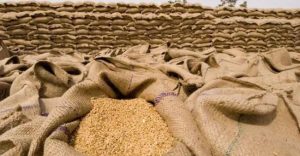 “Will India’s wheat imports lead to global food crisis?
“…The unseasonal heavy rains and hailstorm of March and April this year, which left millions of farmers in north India in distress, may impact international wheat prices… imports may push up the international wheat price as happened in 2010.”
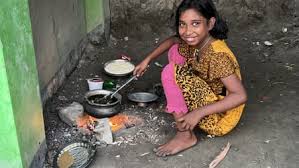 “A childhood carried in water pitchers: Climate change and lost girlhoods in coastal Bangladesh…
“In coastal Bangladesh, saline intrusion is more than an environmental problem — it has become a daily threat to health. Children, especially girls, often walk long distances to fetch drinking water, leaving little time for school or play.”
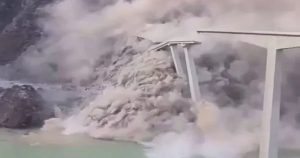 “Repeated raising of dam’s water level despite rising frequency of landslides led to the Hongqi Bridge collapse in Tibet…
“…within approximately seven months, the water level rose by more than 160 meters. This rate and magnitude of rising water set a world record. Just one month after Phase II began, the Hongqi Bridge, located in the heart of the reservoir area, collapsed.”
 “Bach Ma National Park in Vietnam Closes to Tourists Following Historic Floods and Landslides.
“Bach Ma National Park, known to be one of the most popular natural landmarks in Vietnam, is left with no other option but to suspend tourism activities indefinitely due to the series of devastating landslides caused by the record-breaking flood that happened at the end of October 2025.”
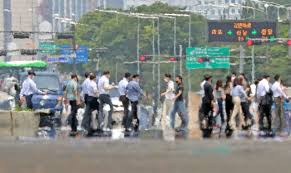 “South Korea’s Heatwave Days Have Doubled Over the Past 113 Years.
“Compared to about 100 years ago, the number of heatwave days in South Korea has increased 2.2-fold. The number of tropical night days has also increased 4.2-fold. While the number of precipitation days has decreased, rainfall intensity has increased, leading to more frequent heavy downpours.”
https://www.dongascience.com/en/news/75755
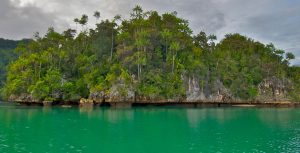 “RECORD HEAT IN INDONESIA: exceptional 37.7C [99.9F] Today at Kaimana, West Papua hottest day in history.
“Kaimana has been with record heat for over 6 years. Since mid 2019 not a single month has been cooler than average and it breaks and rebreaks records continuously.”
https://x.com/extremetemps/status/2005660328642933136
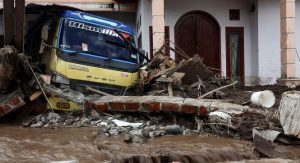 “No New Year fireworks in Indonesia as nation mourns Sumatra flood victims…
“Several governments and police forces, including those in the capital Jakarta and on the popular tourist island of Bali, have said they will not allow firework displays out of respect for the victims on Sumatra, where floods and landslides have killed over 1,100 people, with around 400,000 still displaced.”
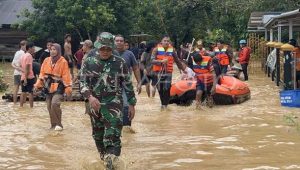 “Floods hit nearly 11,000 people in S Kalimantan’s Balangan District.
“Flooding has affected nearly 11,000 people and submerged more than 3,500 homes across Indonesia’s Balangan district in South Kalimantan, local disaster officials said, prompting authorities to declare a flood emergency as heavy rains continue to batter the region.”
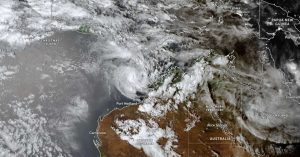 “Tropical Cyclone Hayley bears down on Derby in WA as north Queensland communities face floods.
“…as severe Tropical Cyclone Hayley – now a category-three system – approaches on Tuesday , bringing destructive winds, heavy rain and the potential for flash flooding, the risks are fresh in everyone’s minds. It was only three years ago that rain dumped by ex-Tropical Cyclone Ellie led to catastrophic floods…”
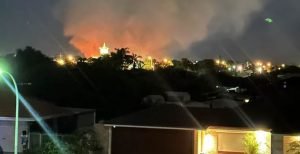 “Bushfire near Rockingham closes Mandurah train line, Warnbro station in Perth’s south.
“Warnbro station and a large part of the Mandurah train line have been closed as unexploded ordnance hampers efforts to contain a bushfire burning in Perth’s south. There is a possible threat to lives and homes from the out-of-control blaze…”
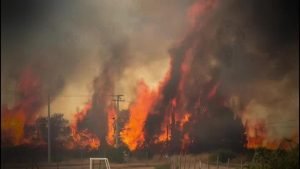 “Chilean capital on alert as fires spread through nearby hills.
“Forest fires put Santiago on alert on Monday when flames blazed through hills in the Las Condes area, after burning at least 470 hectares (1161.4 acres), according to Chile’s National Forestry Corporation (CONAF).”
https://ca.news.yahoo.com/chilean-capital-alert-fires-spread-060301853.html
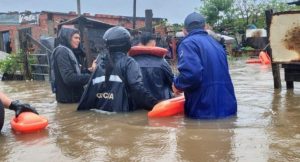 “Floods in Corrientes: serious social situation and lack of provincial infrastructure [Argentina]…
“Officers from the National Gendarmerie and the Argentine Naval Prefecture had to intervene for the evacuation tasks after the Uruguay and Paraná rivers rose. The officers took the evacuated residents to municipal gyms and schools, amid critical circumstances.”
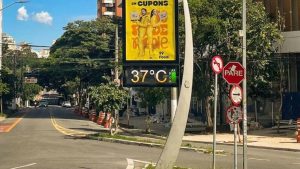 “4 records in 4 days in Sao Paulo Brazil – 37.2C In the Observatory Mirante de Santana (together with Santiago Quinta Normal the oldest in South America) pulverized its December record again.
“YEAR END EXTREME HEAT ALERT – 40C [104F] in Uruguay and parts of NE Argentina and SE Brazil.”
https://x.com/extremetemps/status/2005559413256388672
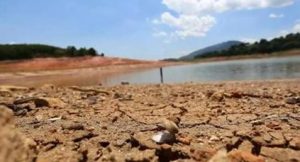 “The metropolitan region of Sao Paulo, the most populated urban area in Brazil, is facing an emergency in its drinking water supply, authorities said Monday.
“According to authorities, the current water crisis is the result of an intense heat wave, a sharp rise in consumption, and a persistent drought that has left reservoirs at critically low levels in the South American area with around 20 million inhabitants.”
https://english.news.cn/20251230/2253cfc0240a4bb2a33fa0ab2d1664d0/c.html
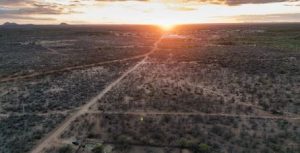 “‘When you plant something, it dies’: Brazil’s first arid zone is a stark warning for the whole country.
“The Caatinga in the north-east has been transformed by the heating climate in just a generation and could become the country’s first desert… earning a living from goat rearing is becoming more difficult as the dry season extends and the native vegetation withers…”
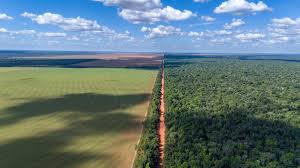 “Soy trading firms to abandon Amazon protection pact in Brazil.
“Some of the world’s largest soybean traders are preparing to break their agreement to curb deforestation of the Amazon rainforest to preserve tax benefits in Brazil’s top farm state, two people with direct knowledge of the matter told Reuters.”
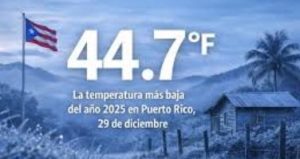 “First cool spell in The CARIBBEAN after 3 years of record heat.
“Most affected were the bigger islands like Hispaniola. Some remarkable Minimums in Dominican Republic, close to records: 12.5 [54.5F] La Romana and 15.2 Punta Cana.”
[Extreme Temps]
https://x.com/extremetemps/status/2005684243448610825
 “Near-Record Cold Nights Recorded Across Antigua and Barbuda.
“Antigua and Barbuda experienced another unusually cold night, with minimum temperatures ranging from 14°C to 23°C (57°F to 73°F) across the country, according to the Antigua and Barbuda Meteorological Services.”
https://antigua.news/2025/12/29/near-record-cold-nights-recorded-across-antigua-and-barbuda/
 “EXTRAORDINARY HEAT IN MEXICO – 40C [104F] recorded in multiple places this week nearly every day even in Northern States like Sonora, Sinaloa, Durango and Chihuhua: never seen before.
“EVERY SINGLE DAY of December Mexico has recorded at least 38C/100F.”
https://x.com/extremetemps/status/2005679954034659694
 “The December US heatwave is ending. It was absurd. Last 7 days: 4700 heat records broken (mins & maxs) vs only 55 cold records. 7 day anomalies as much as +25° F. Dozens of monthly records smashed.
“The heat dome was forced by a very blocky global pattern, but the intensity is virtually impossible intensity without climate change.” [Jeff Berardelli]
https://x.com/WeatherProf/status/2005506374118089049
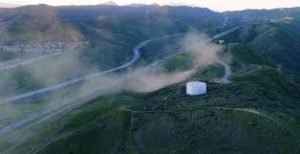 “Heavy rains likely triggered gas line rupture that shut down 5 Freeway for hours, expert says.
“As Southern California Gas Co. crews investigate a major pipeline rupture that triggered a shutdown of the 5 Freeway in Castaic this weekend, at least one expert said that heavy rains were likely to blame for causing massive land movement in the area.”
https://www.latimes.com/california/story/2025-12-29/major-gas-line-rupture-landslide-heavy-rains
 “‘The poor are in a very bad state’: Climate change accelerates California’s cost-of-living crisis…
“Among those affected by rising temperatures is Amanda Nevarez, who was left homeless by the Eaton Fire, one of two wildfires in Los Angeles County that together destroyed more than 16,000 homes and buildings and killed 31 people last January.”
 “Mapped: 16 times extreme weather drove higher food prices since 2022.
“UK potatoes, South Korean cabbage and west African cocoa are just some of the foods that became markedly more expensive after extreme weather events in recent years, according to new research.”
https://www.carbonbrief.org/mapped-16-times-extreme-weather-drove-higher-food-prices-since-2022/
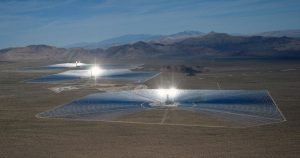 “I have a new estimate: Earth’s albedo (reflectivity) has declined about 0.55% since 2000 (CERES data), the so-called “great darkening.”
“Just to restore the albedo lost since 2000 would require a band of mirrors (92% efficient) circling the earth at the equator about 90km wide.” [Prof Eliot Jacobson]
https://x.com/EliotJacobson/status/2005376638561988800
I rely on donations and tips from my readers to to keep the site running. Every little bit helps. Can you chip in even a dollar? Buy me a coffee or become a Patreon supporter. A huge thank you to those who do subscribe or donate.
You can read the previous “Climate” thread here. I’ll be back tomorrow with an “Economic” thread.

“Why Collapse is Enevable”, part two by Bill Rees: https://tinyurl.com/yvapwxwd
Thanks, Flippr. That’s another terrific article. What a smart cookie Bill Rees is. 🍪
An interesting article recently appeared about the hidden costs of “soil improvement” in Iran — costs that could consume as much as half of the country’s oil and gas revenues. Enormous, without question. But make no mistake: it pales in comparison to what has already become standard practice in Saudi Arabia, where water itself has turned into a basic condition for survival — at an even greater energetic cost.
The Hidden Energy Bill of Saudi Arabia
Anyone who drinks a glass of water in Saudi Arabia is, in effect, drinking diluted energy. Not metaphorically, but literally. In a country without rivers, with depleted fossil groundwater reserves and a rapidly growing urban population, water is no longer a natural resource. It is an industrial product — and one that absorbs a staggering share of the national energy system.
Saudi Arabia is currently the world’s largest producer of desalinated seawater. Roughly one-fifth of global desalination capacity is concentrated along the Red Sea and the Arabian Gulf. Cities such as Riyadh, Jeddah, and Dammam depend almost entirely on water that is first forced out of the sea using large amounts of energy and then pumped hundreds of kilometers inland. Without desalination, modern Saudi Arabia would simply be uninhabitable.
The scale of this system is widely underestimated. Each day, an estimated 9 to 10 million cubic meters of seawater are desalinated in the kingdom — more than 3 billion cubic meters per year. Even with relatively efficient technologies such as reverse osmosis, each cubic meter requires several kilowatt-hours of electricity. Older thermal plants — still an important part of Saudi Arabia’s desalination fleet — additionally consume large quantities of heat, typically generated by oil or gas.
Desalination alone requires roughly 120 to 150 terawatt-hours of energy per year. But that is only the beginning. Water must then be stored, transported over long distances, often pumped uphill, and subsequently reused in industry, cooling systems, and agriculture. Pumps, pipelines, and system losses add tens of terawatt-hours more to the bill.
When indirect water use is included — especially in agriculture, which in a desert climate is inherently energy-intensive — a startling picture emerges. An estimated 25 to 35 percent of all fossil energy consumed annually in Saudi Arabia is used directly or indirectly for water management. In other words, roughly one-third of the country’s total energy production is spent simply to keep the country wet.
This reality has far-reaching implications. Water in Saudi Arabia is not an autonomous sector; it is an energy sink that fluctuates with oil and gas prices, electricity production, and geopolitical conditions. Any increase in population, any expansion of cities, any ambition in industry or agriculture almost automatically translates into higher energy demand for water. The hydrological cycle has been replaced by a thermodynamic one.
Ironically, desalination is often presented as a showcase of technological progress — and in technical terms, it is. But energetically, the system is fragile. It functions only as long as fossil energy remains cheap, abundant, and reliable. Alternatives such as large-scale solar or wind-powered desalination do little to change this fundamental reality. They increase system complexity rather than reduce it: water production requires continuous, reliable output, while renewables are inherently intermittent and therefore require backup capacity, storage, and over-dimensioning.
This makes clear how deeply water and energy are intertwined in Saudi Arabia. Any disruption in energy supply is not merely an economic problem, but an existential one. No energy means no water; no water means no cities, no industry, no stability.
Saudi Arabia thus shows, in extreme form, what is happening more gradually elsewhere: once water is detached from ecology and made fully dependent on energy, it ceases to be a resource and becomes a cost center. The country no longer operates a water system, but a massive energy-to-water conversion machine — one that runs day and night.
Or, more simply put:
in Saudi Arabia, people do not drink water.
They drink oil and gas — diluted, cooled, and delivered neatly from the tap.
What happens when depletion inevitably begins to close the oil tap is easy to imagine. Export volumes will decline far faster than most expect, as the dynamics described by the Export Land Model take hold.
“Or, more simply put:
in Saudi Arabia, people do not drink water.
They drink oil and gas — diluted, cooled, and delivered neatly from the tap.”
And by extension, so does everybody else directly or indirectly dependent on their oil. There are no truly autonomous sectors left. Autonomous is what you call something that someone else is paying for, that no one else (who matters) has noticed and started tweeting about (so, thankfully, you don’t need to performatively protest or feel guilty about this horrible state of affairs to signal your allegiance to the good guys).
Let us not forget that silver is needed to make the electrodes for the desalination plants .
Illuminating and mind boggling, Zip. Also good points by jupiviv and Ravi. We’re all on ONE planet.
No, Bob, we are not smarter than yeast. But I suspect we won’t be making a comeback, whereas yeast has a good chance.
Thanks, Zip – fascinating as ever.
These somewhat low oil prices will be making that water less affordable, of course. Bloomberg and the IMF suggest Saudi’s break-even (budget balance) price is over $90 per barrel.
Saudi really needs to be ploughing all its money into water-catchment/storage, food security, infrastructure resilience etc. and not splurging on prestige projects like Neom, but perhaps it has to do some of that to attract foreign investment. 🤷♂️
Pretty funny, I worked in KSA from1979 to 1985 and we had to fill up our underground tank from a tanker truck (in Riyadh) but you couldn’t drink it. We had to take gerry cans to “the water place” and get those filled with potable water. Almost 50 years has passed and you still can’t drink the water coming out of the tap without a RO system.
Good bye to Dubai — the boob job of the ME .
https://medium.com/globetrotters/goodbye-to-dubai-the-boob-job-of-the-middle-east-242e6d2f8c7f
That coastal Bangladesh story of the 10 year old girl basically doing everything in the house and walking miles for water gripped me.
I just work for some asshole in a parts store in upstate New York and still complain about my life like I’m some sort of victim.
When in reality I should be counting my lucky stars.
Truth Wizard, I often think similarly, but the brain is wired to respond to its immediate environment, not to some global ranking of hardship, so it is hard to bring about a significant deepening of gratitude by reading about those less well off.
Meanwhile, Americans can still get jumbo mortgages to build jumbo homes, and jumbo loans for new jumbo commuter pickups, like that’s the way it’s always been and always will be.
Until the financial system seizes up, I guess, Leaf.
Very true. Thanks again, Pan, for the work you put into this.
Yesterday we discussed SSF . Here is something to munch on :
Everyone’s debating which domino falls first: Japan? Private credit? Equity concentration? Consumer collapse?
They’re asking the wrong question.
I’ve spent 400+ hours analyzing funding market data most analysts never see.
Here’s what I found:
All four risks share ONE hidden vulnerability.
Cross-currency basis dislocation + repo market stress.
When that channel spikes, they don’t fall sequentially.
They fall TOGETHER. Within days. Not months.
The evidence is already flashing:
→ Treasury fails hit $30.5B last week. 8-year high.
→ Fed’s RRP buffer: collapsed from $2.4T to $1.5B. Gone.
→ Japanese hedge ratios at 14-year lows. Exposed.
→ Public BDCs pricing 10-15% defaults vs 2% reported.
→ Subprime auto at 15.78%. Above 2008 peak. Right now.
The mainstream sees four separate problems.
I see one detonator.
My prediction:
If JPY/USD cross-currency basis widens past -75bps for 5+ days before March 31, 2026, you’ll see synchronized forced selling across Japan, private credit, AND equities within 72 hours.
Not sequential dominoes.
Simultaneous collapse.
The window is January-March 2026.
The BOJ meets January 22-23.
The Fed meets January 28-29th.
Japanese fiscal year-end is March 31st.
Nobody is watching the right indicator.
https://x.com/shanaka86/status/2005293466838786312
Ravi, we shall see. What he says about liquidity and funding stresses potentially causing simultaneous problems across multiple asset classes makes sense to me.
I am not giving financial advice but just pondering on the trends evident in C & E today.
What companies make plastic & metal water jugs in all sizes suitable for all ages to arduously carry water for miles? As full-blown exhaustion inevitably arrives during the return trek: what model designs minimize the chance of spillage thus necessitating a repeat trip to the borehole?
The criteria should be what jugs cause the least number of salty tears & cries of pain per mile or kilometer?
Many balance heavily laden jugs on their heads, others blister their hands and damage their arms from brute force lugging under the blazing desert sun. I have seen the pic of the porter heavily bent under the wooden yoke while balancing two pots: this repetitive motion over a lifetime of plodding must eventually cause extreme shoulder & spine pain.
Shouldn’t this be our Collapse Olympic Sports? Will this inspire the toddlers and youngsters to greater glory as the distance to the next dug well will only increase as the easiest well empties first?
Have you carried two five gallon water jugs any distance today or up some flights of stairs to celebrate their tasks? Or do you just turn the faucet tap while humming ‘Taps’?
Or would a better investment be in owning stock in a maker of heavy clay pots because plastic and steel will go bye-bye?
Bob Shaw Are Humans Smarter than Yeast?
“Margaret Lankoi, [a] 27-year-old mother of four from rural southern Kenya already is feeling the effects of frequent, long-distance treks for water. The chore is especially arduous in the long dry season, each trip taking her up to 10 hours…
“She packs up to four jerrycans on two donkeys and often carries one 20-liter jug herself. Margaret harnesses the jerrycan with a strap and wraps it around the top of her head, resting the 44-pound container on her back.
““Though I must carry it on my back, it’s not easy,” she says. “I often feel pain in my back, but there’s no choice.”
“Some days she’s too tired to go, but what other option does she have? The family wouldn’t have anything to eat or drink if she rested two days from collecting water.”
https://www.worldvision.org/clean-water-news-stories/carrying-water-pain-neck
Thxs for the additional info, Pan. I just hope that people in North America & Europe are in sufficient physical condition to haul water like Margaret Lankoi.
As it is a jug with 44 lbs of water is heavy. But the water sloshing inside with every step can make it easier to lose your balance or stumble.
I haul 5 gallon jugs from the lake to my off-grid cabin up above 50 North. Being 70 years young, I utilize a two-wheel dolly to help minimize the chance for muscle strain or injury, but I still must tread carefully if snow or ice is underfoot. The distance is roughly 90 yards and up about 20 feet. I bet Margaret Lankoi would easily beat me in a race.