


Mike Tyson famously said: “Everyone has a plan until they get punched in the face.” My “plan” was, until the climate becomes unlivable globally, to live in my quiet corner of the world that is WAS one of the best places to be in the unfolding climate crisis: the mountains of western North Carolina, in the southern Appalachians. We are hundreds of miles inland and mountainous, and hurricanes rarely affect us here. When they do, it’s usually just heavy rain because hurricanes typically weaken tremendously as they go inland.
So no one here was expecting what happened with Hurricane Helene. Which actually was officially a “mere” tropical storm by the time it got here. If you had told me on Sept. 24th this region would be in the crosshairs of the deadliest mainland US storm since Katrina, I would have laughed out loud. A few years back, I was discussing climate change with a friend of mine who lives in Asheville. She is no denier at all, but she said so far it really hadn’t affected her in Asheville, which was true. Obviously that changed dramatically with Helene. The reality of climate change really hits home when it affects, well, your home!
On Wednesday, September 25, 2024, I was doing my weekly food shopping. As I finished checking out, the worker said “Have a nice day. And stay safe tomorrow.” I nodded and went out to my car, thinking, “What was she talking about – stay safe?? What is going on?” I knew Hurricane Helene has been in the gulf but was unconcerned. I was soon clued in by a friend.
Around 3:00 PM it started to rain. And it rained very hard for almost two days, winding down around 11 AM on Friday, Oct. 27. My power went out at 8:15 AM on Friday. Also, the cell signal went down, which never happened before. A big difference!
Power lines in my neighborhood are underground. I’ve only had power out a few times in many years and the longest outage was maybe 12 hours. So we kept the refrigerator closed and hunkered down, expecting power to be back on before long.
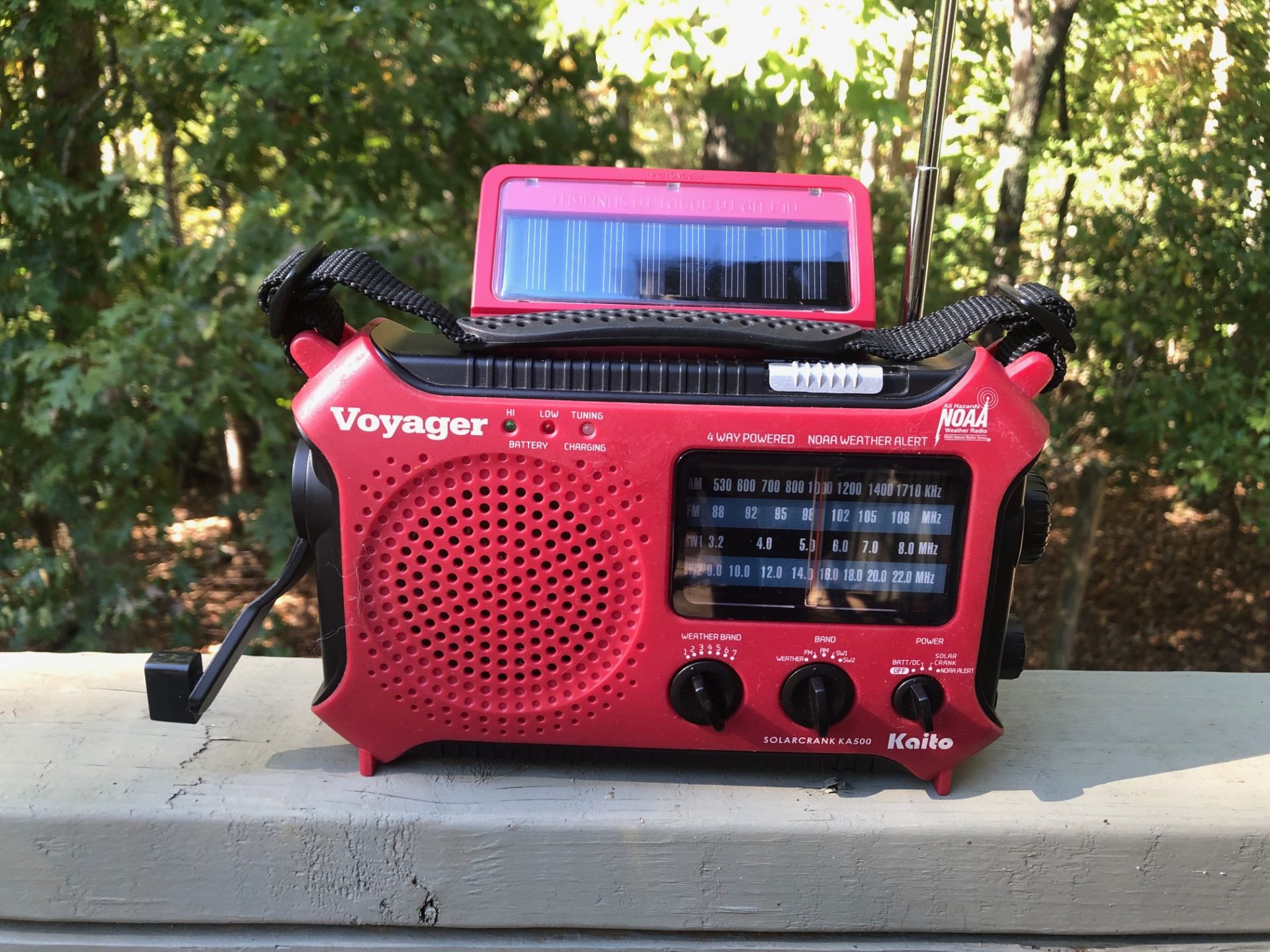
News junkie that I am, it was definitely strange not to know what was going on in the world, much less right here. Since we had no internet access, not long into it, I pulled out my emergency radio which has weather bands, AM & FM and a few short wave radio channels. It can be powered by batteries, a built in solar panel or a hand crank.
As the days unfolded I found a station that was broadcasting live, 24/7, commercial free, with news, information, and much appreciated support. “We know it’s bad, but help is coming. You are not alone.” It made a difference to me! They became a communication hub with people calling in and going live on the radio, telling about what they experienced, what they needed or what they could offer to help – food, water, chainsaws, etc.
Of course the major contribution of climate change to this storm was NEVER mentioned, not even by the weather channel guy. Sigh.
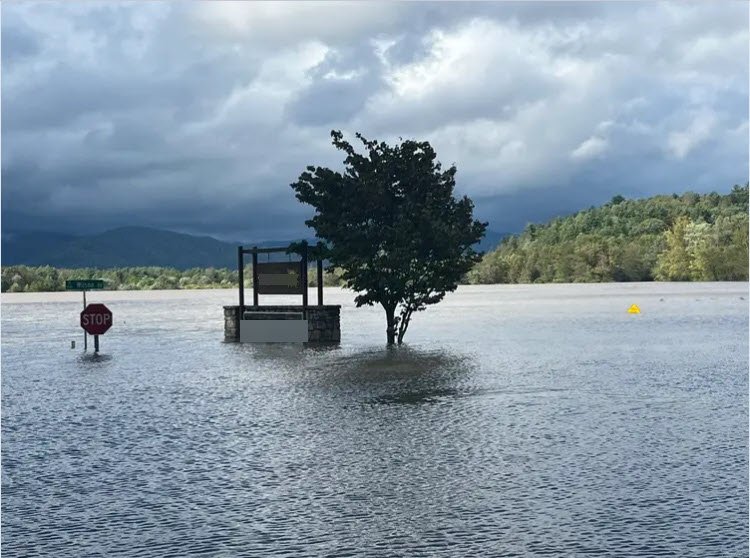
Saturday, September 28th a friend texted me “The flooding looks so bad where you are, my God. I am thinking of you.” I didn’t get this text until Monday when I heard a local credit union had about the only cell signal in town and I went over there.
Days after the rest of the world knew how bad the storm had been, I started to learn. I kept saying to myself “Wild!!!” It really was shocking. My small town of Brevard is 30 miles from Asheville and fared much better than many other towns. The main river here is much smaller than it is in Asheville. We have a flood plain that is used for agriculture. Still, the water went higher than I have ever seen it in 15 years. Photo is the entrance to my neighborhood.
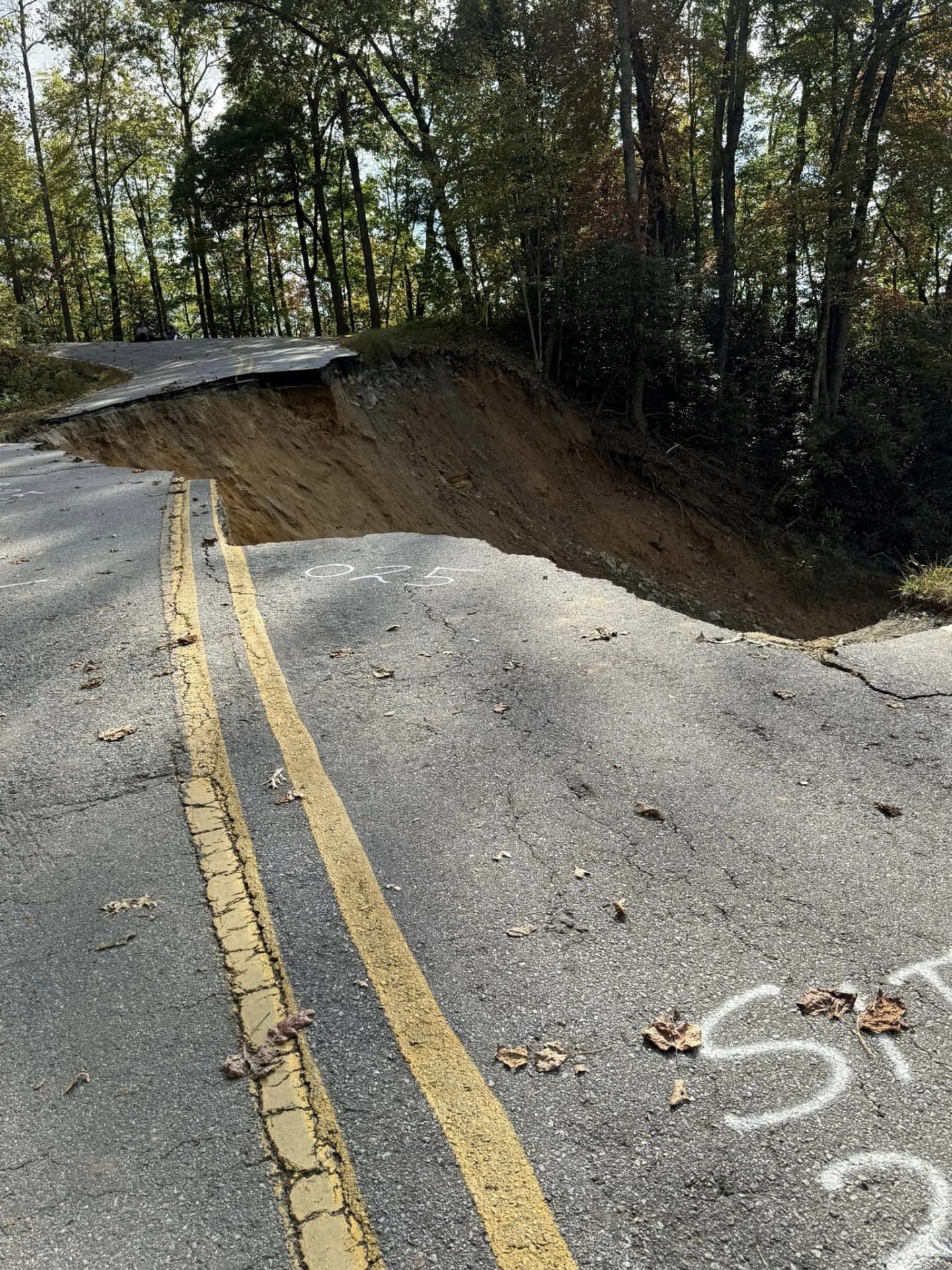
Zillions of trees down, power out in so many places. Roads washed out. In the worst areas north of me, massive flooding and landslides swept away houses and people. I won’t try to document all that happened and the following rescue and recovery efforts, which you can read elsewhere in many places. The photo is of Becky Mountain Road, I have some friends who live up that road. There is another way out but much longer to town.
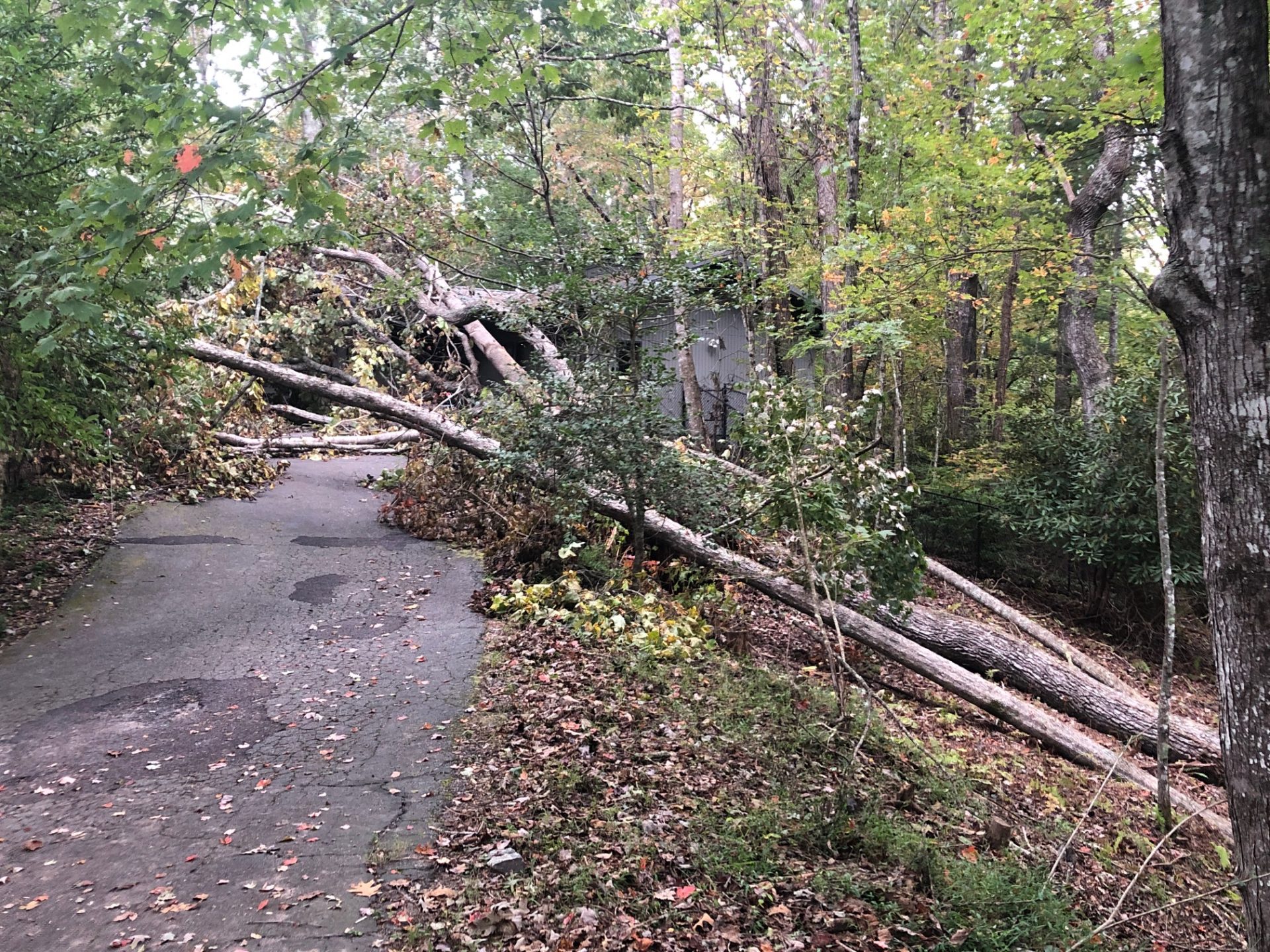
Brevard is nestled next to the enormous Pisgah National Forest and my neighborhood is completely wooded. Fortunately no trees fell on my house. My next door neighbor had five trees fall on her house. She said she watched them fall, a slow fall that damaged the edge of her roof slightly but thankfully did not go through the roof. Others did not fare so well. I hear a house one neighborhood over had a big tree go through the middle of their house, ruining it completely.
A huge tree fell across the road out of my neighborhood. Cars could drive under it!
Just a few things about my experience. First, I did have some decent preps, though I am not a “prepper” and have never aimed to try to survive longer term (good luck with that). This proved to be a good test of what I had and what needed beefing up. It also made me confident about coming through this storm. My neighbor across the street came over probably on Saturday after the storm wondering about food and water. I offered help but she said she heard a certain restaurant in town was open so they could get food there. I think A LOT of people are minimally prepared for any disruption.

My LED battery powered lanterns and headlamps worked great.
I have three 50 gallon rain barrels, so I had plenty of water to flush toilets. I had about 15 gallons of stored drinking water which have spigots making it easy to set on the counter and get the water over the sink. I have a Berkey water filter if I needed to filter the rain water, which I never did.
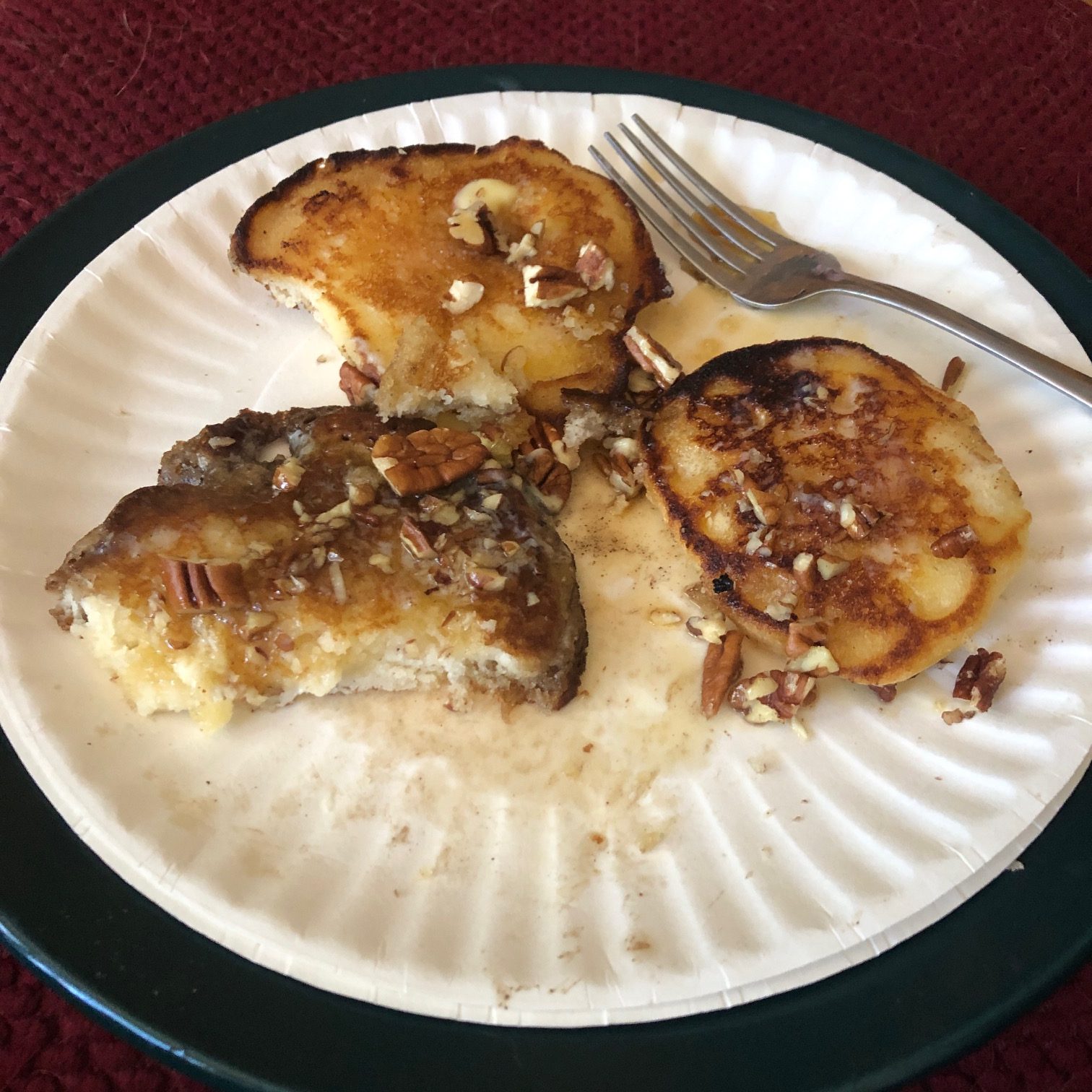
After a day or so I loaded food from the refrigerator and freezer into coolers and we ate up what we could. After that, I had survival type food and we had some of that. It was definitely edible. Spaghetti and meat sauce was one and the other was mac and cheese. The pancakes were delicious! 🙂
But we did start to crave fresh food. Power came back in town and restaurants opened up so we got take-out a few times. It was also truly great to have a gas cookstove. Most people hereabouts have electric stoves. I have quite a bit of propane which fuels the stove as well as a backup wall heater. Helpful when your main source of heating and cooling is a heat pump.
Speaking of which, we were also lucky to have good weather. This being shoulder season – not too hot or cold – no heat was even needed during those 12 days.
Many times a day I listened to the radio. It was great to hear how people were helping out. My own neighborhood started to have daily noon meetings to share information and resources. This seemed to happen all over the place. It was nice to see humans leaning in and helping each other. I met quite a few people in my neighborhood I hadn’t known before. Craving community, people were walking the roads and happy to chat.
You might think peace and quiet would descend in such a scenario however that was not the case as chain saws and generators were fired up. I don’t have a generator but I had two decent charging batteries as well as a solar charger so we could charge our cellphones and ipads. About a week in we started to get a faint cell signal from home.
Until that signal came back, with no access to the internet, my personal and professional life came to a screeching halt. I thought the silver lining would be that I had time to more deeply ponder our overshoot trajectory. However, as it turned out, I was quite busy every day! Lugging water, neighborhood meetings, going out to try to get a cell signal and let people know we were OK, etc. I wish I had kept notes of what I did every day, but I know I was running around most of the time.
The days ticked by with no power. Duke Power said most people would have power back by Friday, Oct. 4th. That came and went. I took a blessed hot shower at a neighbor who had gotten power back. Finally on Tuesday, Oct. 8th our power was restored. Hallelujah! I did a happy dance and a lot of hooting and hollering. After all, I have been an IC (Industrial Civilization) slut my whole life. TWELVE DAYS! That was the longest I had ever been without power except by choice, on hiking trips.
I am going to store a little more drinking water, resupply my gas lighters, stock up on some more batteries and pet food. Locate some disposable bowls and more paper towels! But overall, we did fine.
Truth be told, though, the longer slow collapse unfolds, the less I want to survive when the grid goes down permanently. I don’t want to wait around too long to see if the grid is down for good or not. I think we will be able to tell from shortwave radio or lack thereof. I am sure that humans will not be so nice and cooperative when the generators run out of fuel and no neighbors have food or water.
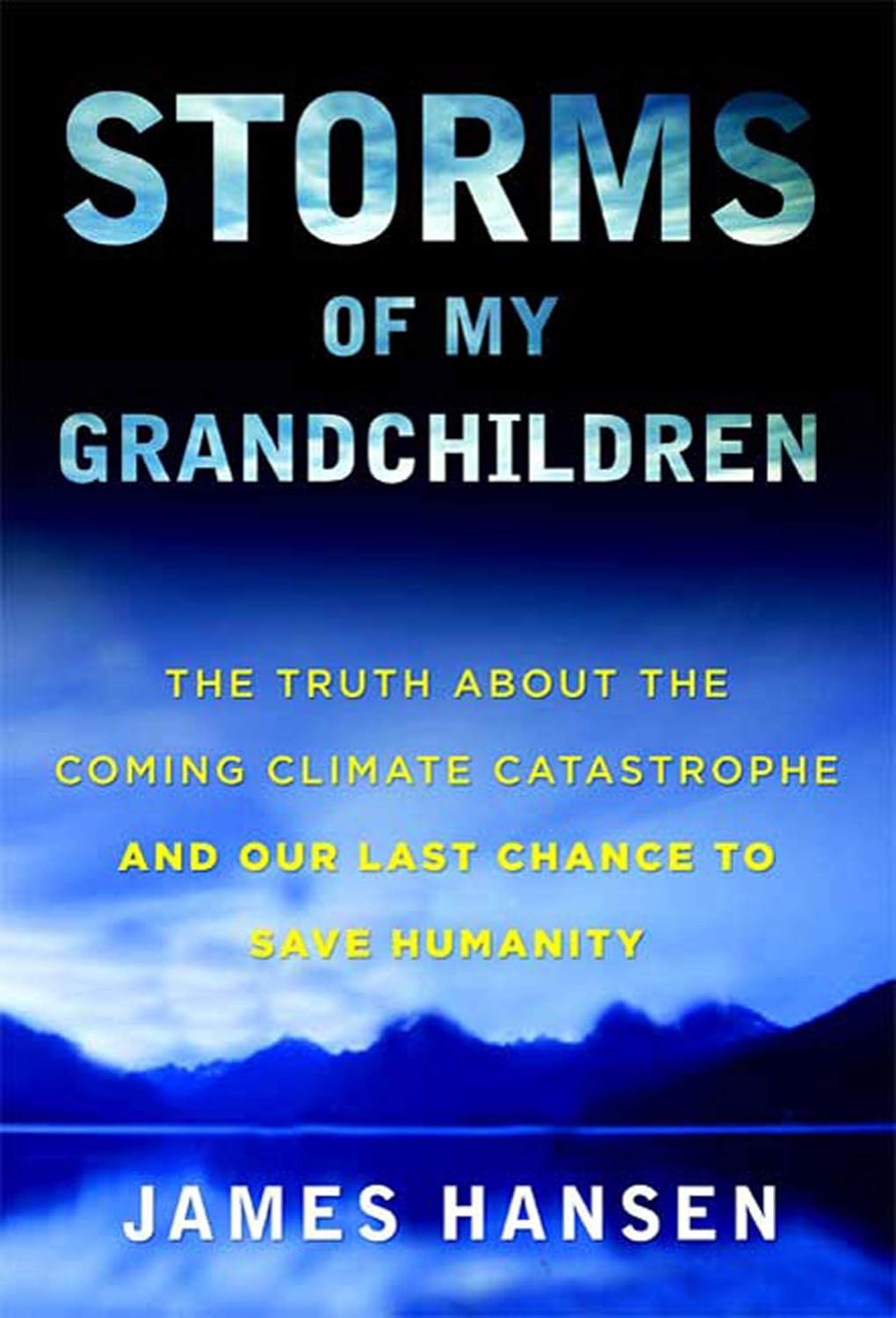
I have a neighbor who recently bought a second home here to escape the Florida heat. I had noticed that they left town after Helene, most likely back to their Florida home. Many people who had the means did the same – leaving the area for a while until things were restored. Today I saw their car in the driveway. Probably they had come back to escape Hurricane Milton!! How long can people run to escape James Hansen’s “Storms of My Grandchildren” (published in 2009), which are here, now?
That’s my story of how I survived “Katrina of the Mountains.” Some preparation but mostly a lot of luck!
My takeaways:
• Nowhere is safe – expect the unexpected. (Which is probably an oxymoron, now that I think about it.)
• If only a region is impacted, tons of help will come in to clear roads, get the power back on, bring in food, water and all the supplies needed. If one of the three USA grids goes down – or all of them – there won’t be enough help coming. (Similar in other countries.) Seems like Mad Max was predictive programming.
Your thoughts and own experiences welcome below. Thanks to Panopticon for posting this. I hope it is somewhat interesting.

Thankyou for sharing that, you must feel pretty lucky to have escaped the devastation alot of people suffered there. I’m actually surprised that the area would be considered a climate haven. After watching all the wreckage it looks like the topography of that area is similar to Vt where there are roads running through gorges with mountains on either side that go straight up leaving nowhere for the water to go. And isnt it hotter than hades down there , with the humidity?
I bet everyone has anxiety now every time it rains! At least it helps bring the community together and will help you to shore up how to prepare when it happens again.
It definitely feels like we have moved to another level of global weirding these past 2 years. In my memory 2016 was when I really noticed the next level of heat and humidity and 2023 seemed like we took another leap into the collapse. It truly is frightening to see how fast it is accelerating now. Just shows you no place is safe.
Thanks, EMJ! Yes I do feel very lucky and I’m well aware that people around the world in poorer countries are being wiped out by similar in greater numbers than Helene.
Yes, everyone has rain anxiety however it’s been quite dry now since then. Hopefully not too dry. We had a two month drought last fall that scared me but fortunately didn’t go longer than that.
No it’s not hotter than Hades down here. It is a fantastic climate historically. We are at about 2000 feet above sea level so the climate is more like northern New Jersey. The rest of the South which is much lower does indeed get quite hot and humid. Lots of ex-Vermonters here, including me.
I agree the climate is changing faster than ever. Carpe diem!
Thank you for the story. The one thing i keep reading about on line and on YouTube many say they were prepared but not for this one. Surprised by those prepping ones who also had holes and discovered they were surprised by this event too. I have also have some emergency supplies to a point. But in the end it will not matter either as things deteriorate and weather events get so bad you can’t fix things.
Thanks for reading! Yes, everyone discovered the holes they had in their preps, if they had any. That’s why some of these crazy theories are popping up about TPTB directing the hurricane toward this region, which leans conservative except for Asheville, to help throw the election, since voting will be impaired. The amount of extra moisture in the hurricane plume (+50%!!! I think Panopticon told me) was nuts – far beyond our comprehension.
And I agree conditions will overwhelm everyone at some point!
“ Truth be told, though, the longer slow collapse unfolds, the less I want to survive when the grid goes down permanently. I don’t want to wait around too long to see if the grid is down for good or not”
I understand your perspective, prepping will only get you so far.
I curious, if/when the grid goes down permanently, what would you do? “Check out” somehow?
Sorry if this is too personal but I am pondering my options in the same scenario.
I have my charcoal grill ready for that sole purpose. Quick, deadly and from what I understand painless other than perhaps a slight headache. My prayer is that is how I go out rather than by violence of others. It won’t be by starvation. Not going to wait around that long! And pets can go too. This is a method that many people have used in different situations. The ultimate prep! 😁
Thank goodness you had made some preparation. I have had a Berkey water filter for some time, but that is pretty much it. If we get to the stage of filtering water I dread to think what else will be happening.
I am always so cheered by how Americans (is that too broad?) help each other out in times of crisis, Back when Katrina was happening I read blogs (there was so little in the paper) and could read of people trying to get into the area with trucks full of water and being turned away … don’t get me started on my conspiracy leanings!
I person I worked with flew to America and on the way met a couple who lent her and her husband keys for their apartment – just amazing kindness.
Also a woman writing in The Guardian (btl) wrote that a tree fell across her drive and a total stranger lept out of his truck and chopped it up for her – would accept no money. That was a couple of years ago
Maybe people will support each other more than you think?
Yes, so many people helping each other. Very heartening. Where are you? In the UK? Would people not help each other there?
As for will they help each other more than I think, initially they will but when resources run low I think it will be a different story.
Yes, UK.
During Covid lockdown there were many examples of people helping neighbours out, maybe we will not be so bad.
But – I’ll give you an example
Many years ago there was a programme on TV about a chap and his team who used to help people in need by rebuilding their houses, providing furniture, etc. Many, many people in the area used to muck-in. Businesses used to give items needed – 100’s would cheer the family back int their “new” home.
Same chap came over the England – attempted to provide a park for children in a specific area – it looked like about 30 people turned up to help with minimum support from local business. I was appalled and ashamed.
I pondered that maybe it was the “wagon train” culture that enabled people in USA to jump into support when really needed.
There was also research that showed “collective” communities in USA which was very interesting.
Alas environmental psychology has almost been wiped from universities here …
But here is an AI link: https://shorter.me/r5kxb
Thank you for your vivid and empathetic report.
Funny quote from Tyson! When we bought this house high in the mountains 25 years ago, we were warned. Snowstorms and especially ice rains could cause days of long power cuts. But yes over the decades that we have lived here, the chances of power cuts have become less and less. The number of snow days has been decimated by very palpable and visible global warming. One problem has been added though the fibre 4G networks which, like the power supply is above ground, is yet also extremely susceptible to storm damage.
Last year with difficulty counted a snow week. The ski centre near here has partially converted to an ‘adventure park’ with a sort of toboggan run. Ski hotels are as good as closed. So yes emergency plans are gathering dust in the cupboard. I myself still have all kinds of ‘separated’ systems. A well with safe spring water next door, gas for cooking and wood for heating and oil lamps with lamp oil with lamp oil for a fortnight. Electricity storage or generators I have not started. Somewhere there is a limit.
Actually, the biggest problem at the moment is that all central heating systems, even those that run entirely on wood and pellet stoves immediately stop functioning when the power goes off.
A few years when the power went out after an ice rain and my ten anyway, it was quick for the my villagers who had to leave their homes within a few hours anyway. They still managed because the snow ploughs here work very accurately.
The damage caused by a sudden local storm here in especially the side valleys 6 years ago in the middle of summer was considerable. It took years to repair all the damage. But yes that was in the valley though in the same municipality and it took more than a year before the support measures were paid out and preventive measures were taken in hand improving the flow of tributaries.
We are used to some things here in that respect…. There are periods of heavy rainfall almost every year, made heavier by the extremely warming waters of the Mediterranean. Even this week they are announcing another so-called ‘period Cevenol’ with rainfall amounts of up to 200 litres in one day. All rivers and for the Loire whose upper reaches I live on are well protected against this by now with many ‘water works’ that can regulate the river level well, Cost a lot of money by the way!
That’s all very interesting, Zip. Obviously efforts have been made in your area to be more resilient. But ultimately of course it won’t be enough there or anywhere.
Thanks much for your report. I lived in Asheville several years ago and it has been a favorite weekend escape spot.
Our little town was also devastated. Damascus, Virginia is home to the Virginia Creeper Trail, rated as one of the best rails-to-trails conversions in the country. Now there are fourteen of the trestles between Damascus and the top of the mountain either destroyed or badly damaged. The road to White Top Mountain, used by the shuttles to carry bicycles and riders up the mountain, is very badly damaged. The other road to the east is also badly damaged, leading into Tennessee and North Carolina. Beacuase we are surrounded by national forests on three sides, we have essentially become a dead end town.
The lifeblood of the community is gone, at least for years.
The Appalachian Trail goes through downtown, and even that was rendered unusable by the storm.
Four people I know almost drowned, many houses and businesses were lost.
The upper corner of our property is at 2,000 feet. We are over 300′ above the large creek and South Fork of the Holston River, but when we went out to get a few items, we returned to find that our road had already flooded at both ends. We parked in a neighbor’s yard in what see ed to be a safe place. The river rose another six feet. Car was totaled.
Like any who read C&E, we are “practical preppers”… not looking for long term survival.
But as some have mentioned, some supplies are getting old,as am I. We have several layers of essentials in most categories, so other than the car loss, we fared pretty well.
But our town may be damaged beyond repair, at least for a few years
Thanks for the report and I am so sorry to hear how your town was affected! I rode the Virginia Creeper trail a few years back and absolutely loved it. What a gem that has been devastated. I think the economic impact on Damascus, Asheville and so many towns will be immense. A client of mine had her Biltmore Village business wiped out. No flood insurance. All gone forever. Fortunately she has another location and she will be OK, but all the losses are shocking. The way things are going now on all fronts (climate, economy, geopolitically, etc.) I wonder if much will be rebuilt. I saw that some folks down on the gulf were still rebuilding from a bad hurricane a few years ago when Helene hit them.
Very insightful writeup and great comments here, as always. Thanks so much for sharing your story, Cassandra, and many thanks to our gracious host Panopticon for sharing his platform. Glad that you came through the storm mostly unscathed!
Thank you, PJC! I was hesitant to share it, as I wanted to go deeper and wider, but I did the best I could and I am glad it has been interesting to some readers. Yes, I am grateful to Panopticon for the opportunity.
“…many thanks to our gracious host Panopticon for sharing his platform.”
You are welcome – my pleasure! And thank you all for the comments. ❤