

Huge thanks to my sponsor for March, the splendid Professor Pongoo.
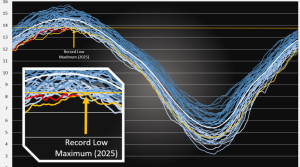
 “Arctic sea-ice extent just set a record daily low extent, about 4,400 km² below the previous record daily low, set just last year.
“Also, extent is still on track to set a new record low maximum. Stay tuned!”
[Prof Eliot Jacobson]
https://x.com/EliotJacobson/status/2033535035027198299
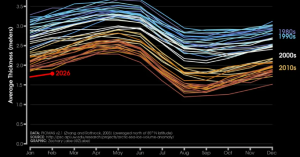
 “The average sea ice thickness around the North Pole continues to set monthly record lows, according to the PIOMAS dataset. Each line represent one year from 1979 (blue) to 2026 (red)… note the trend too.
“More graphics at my website [Zack Labe]:”
https://bsky.app/profile/zacklabe.com/post/3mh3zyzddic2h
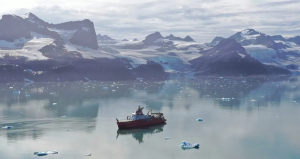 “Meet the scientist heading to Greenland’s fjord glaciers to understand their ‘climate tipping point’…
“An international team of scientists is determined to understand just how quickly Greenland’s melting glaciers are pushing the Atlantic Ocean towards a “critical climate tipping point”.”
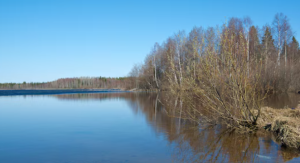 “EXCEPTIONAL WARMTH IN [ARCTIC/NW] RUSSIA.
After a cold winter, Northern Europe, including Scandinavia and The Baltics are seeing an exceptionally warm March. March Records were broken today in Russia: 16.8 [62.2F] Sar Ja, 14.7 Nyuksenitsa, 14.7 Dvinskij Bereznik.”
https://x.com/extremetemps/status/2032896179865006529
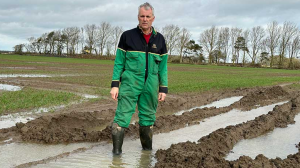 “Wet winter brings long-term problems for farmers [UK].
“Record-breaking rain over the last three months has created long-lasting problems for farmers across the South West. Parts of Cornwall and Devon have seen rainfall totals reach about 150% of the long-term average, forecasters said.”
https://www.bbc.co.uk/news/articles/cd6zd9xzypxo
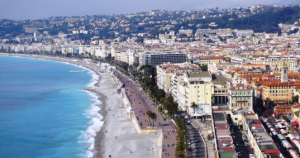 “Over last 2 months, the national temp. anomaly for France has reached +3 °C/1991–2020, crazy for a 60-day period!
“Warmest ever recorded late winter at +9.4 °C, far ahead of +8.7 °C in 1990 (at the time, Feb. 1990 was considered an exceptional winter heatwave!)” [Melaine Le Roy]
https://x.com/subfossilguy/status/2032789767490769259
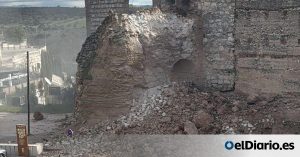 “Mediaeval tower collapses at historic Escalona Castle in Toledo [Spain]…
“Spain’s mediaeval heritage faces recurring threats from time and weather. In April 2025, heavy rains led to the collapse of the iconic Barbacana tower at Almonacid de Toledo’s Muslim-origin castle, another Toledo province site listed on heritage danger registers.”
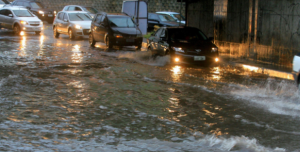 “Bad weather in Sicily: torrential rains in the Catania area, flooding between Mascalucia and Pedara.
“A violent cloudburst hit the Catania area, causing inconvenience and flooding in several areas of the province. The intense rainfall has transformed some roads into real torrents.”
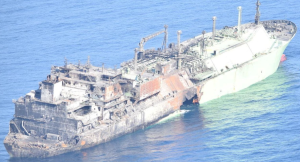 “‘Ticking time bomb’: Stricken Russian fuel tanker drifts near to Italian islands.
“Maritime authorities have warned mariners to steer clear of a crewless Russian fuel tanker that has been drifting between Italy and Malta for days after an alleged drone attack, prompting fears of an environmental disaster.”
https://edition.cnn.com/2026/03/16/europe/arctic-metagaz-russian-fuel-tanker-italy-malta-intl
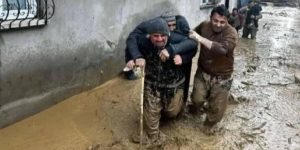 “Flood and landslide on camera in Şırnak: Security guard escaped in seconds [Turkey].
“In the flood in the Uludere district of Şırnak, a security guard working at a construction site escaped from the rising waters at the last moment. Those moments were captured on security cameras.”
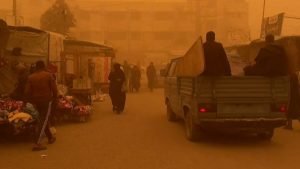 “Severe sandstorm sweeps through Gaza tent camps…
“Families in areas like Khan Younis and Gaza City say powerful winds repeatedly collapsed tents, worsening already dire living conditions after months of conflict. Meanwhile, violence has continued despite a ceasefire, with casualties reported in recent weeks.”
https://www.france24.com/en/video/20260315-severe-sandstorm-sweeps-through-gaza-tent-camps
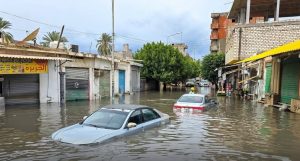 “Heavy rain floods streets in the city of Zawiya [Libya].
“The Libyan Red Crescent, Al-Zawiya branch, declared a state of emergency. They raised their alert and full readiness levels. This supports local authorities. It aids rapid response and intervention operations. These actions address the emergency conditions.”
https://libyaupdate.com/heavy-rain-floods-streets-in-the-city-of-zawiya/
 “Sea levels around Africa are rising faster than the global average: what’s behind this alarming trend.
“African sea levels are rising by approximately 3.54 millimetres each year, which exceeds the global average of 3.45 mm/yr. Perhaps more troubling is that the pace of rise is speeding up, especially in African waters.”
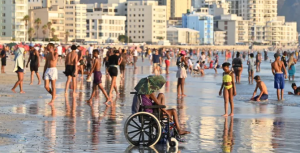 “SOUTH AFRICA OVEN:
“44.3C [111.7F] today At Alexander Bay right on the ocean coast. The 4 hottest days in Alexander Bay climatic history were all recorded this week. Absolutely insane. Previous all time record was 43.5C.”
https://x.com/extremetemps/status/2033190725630967969
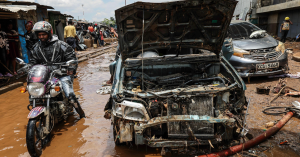 “Flash Floods Claim 66 Lives as Kenya Reels from Torrential Rains.
“The deluge, which has battered several regions over the past 72 hours, serves as a grim reminder of Kenya’s precarious struggle with meteorological volatility. As the death toll rises, the tragedy has exposed severe gaps in urban planning, disaster preparedness, and the resilience of national infrastructure.”
https://streamlinefeed.co.ke/news/flash-floods-claim-66-lives-as-kenya-reels-from-torrential-rains
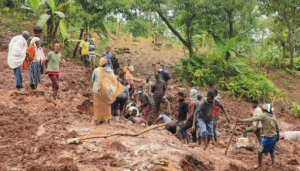 “Death Toll from Ethiopia Landslides Rises to 125, Thousands Displaced…
“Authorities in the South Ethiopia Regional State said the landslides struck several areas in the Gamo Zone following days of intense rainfall, causing widespread destruction and forcing thousands of residents to flee their homes.”
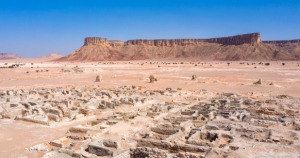 “MIDDLE EAST HEAT WAVE:
“The hot air from Central Africa moved Northeast and settled in the Middle East. First 40C [104F in 2026. In Saudi Arabia 40.0C Wadi Dawasser 700m asl; 36.4C Bisha 1162m asl. Around record levels for mid March and close to monthly records.”
https://x.com/extremetemps/status/2033613573596058118
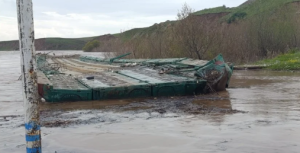 “Floods and heavy rains put Semalka border crossing out of service.
“Semalka border crossing, which links the Kurdistan Region of Iraq to areas in north and east Syria, has been temporarily put out of service due to floods and rising water levels, after heavy rains hit the region over the past hours.”
https://www.syriahr.com/en/379555/
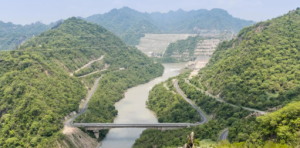 “‘Water War’ rages as India-Pakistan tensions reach boiling point.
“Last week, water became a focal point in the Iran war, as airstrikes hit desalination plants in Iran and Bahrain. Further east, a slower motion water war was playing out — one that is heightening tensions between two nuclear armed powers.”
https://responsiblestatecraft.org/india-pakistan-water-war/
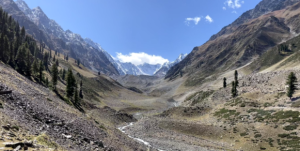 “The driest spring in four centuries in the Western Himalayas…
“To build the climate record of Lahaul through tree rings, the researchers chose three places — Udaipur, Salpat and Trilokinath. They collected 88 cores from over 50 trees. “Most of the time we were working on a steep incline. It’s very risky,” said Pandey.”
https://india.mongabay.com/2026/03/the-driest-spring-in-four-centuries-in-the-western-himalayas/
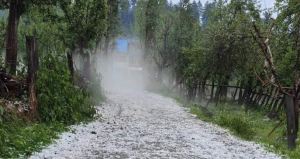 “Hailstorm Ravages Crops, Apple Blossoms in Central Kashmir.
“A sudden hailstorm struck Kanidajan and nearby villages in the Pakherpora area of central Kashmir’s Budgam district on Monday late afternoon, damaging standing crops and apple blossoms and raising concerns among farmers about potential losses to the upcoming harvest.”
https://kashmirlife.net/hailstorm-ravages-crops-apple-blossoms-in-central-kashmir-428613/
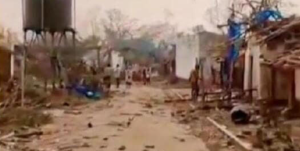 “Rare tornado kills 2 in Odisha’s Mayurbhanj district, India.
“A rare tornado struck near Tato in Odisha’s Mayurbhanj District on March 15, 2026, killing at least two people and injuring 29 others who had to be hospitalized. More than a hundred homes have reportedly been damaged and destroyed.”
https://watchers.news/2026/03/16/rare-tornado-kills-2-in-odishas-mayurbhanj-district-india/
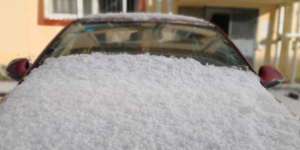 “On March 15, 2026, strong convective weather suddenly struck multiple areas across Yunnan Province, China.
“In Jinghong, the capital of Xishuangbanna Prefecture, a rare hailstorm drew widespread attention from local residents and online communities.”
https://www.youtube.com/watch?v=E8oD2YV_oKc
 “Indonesia readies 35 cloud-seeding ops amid El Niño threat…
“Meanwhile, the ministry’s Director General of Law Enforcement, Dwi Januanto Nugroho, said that given the prolonged El Niño conditions, OMC operations could be effectively implemented for 10–12 days, with two sorties or flights conducted daily.”
https://en.antaranews.com/amp/news/408702/indonesia-readies-35-cloud-seeding-ops-amid-el-nio-threat
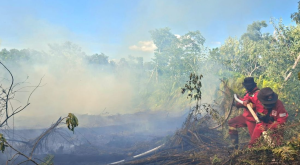 “Thick smoke from Riau forest fires disrupts Hari Raya travel for Indonesians.
“Thick smoke from widespread forest fires in Riau has disrupted the Idul Fitri (Hari Raya Aidilfitri) mudik (exodus), reducing visibility to just 10m on key roads and raising safety concerns among travellers.”
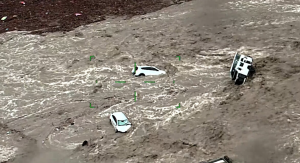 “Australia battered by climate ‘whiplash’ as Climate Council warns of dangerous new era of extreme weather…
“The whiplash effect is typified by flash flooding washing cars out to sea along Victoria’s Great Ocean Road, which was sandwiched between a period of catastrophic fire warnings and then a second bout of extreme heat.”
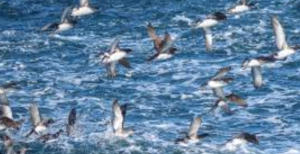 “Seabirds struggled to raise chicks in the Hauraki Gulf this summer. What happened? [NZ]
“Some seabirds breeding in New Zealand’s largest marine park struggled to raise chicks this summer, most likely because climate change is forcing them to travel too far in search of food. The Hauraki Gulf Tīkapa Moana is a global hotspot for seabirds…”
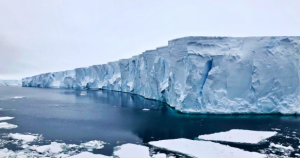 “Models warn Thwaites Glacier could rival entire Antarctic ice loss by 2067…
“Thwaites Glacier is already one of the fastest changing and most closely watched glaciers on Earth, losing ice more than five times faster than in the 1990s. It drains a huge area of the West Antarctic Ice Sheet and outlets into the Amundsen Sea.”
https://phys.org/news/2026-03-thwaites-glacier-rival-entire-antarctic.html
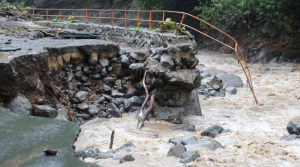 “Hawaii storm dumps up to 46 inches of rain, breaks decades-old record.
“The island of Maui saw the heaviest rainfall, with multiple areas reporting over 20 inches of rain and one location logging as much as 46 inches of precipitation March 10-15, according to the National Weather Service.”
https://www.sfgate.com/hawaii/article/hawaii-storm-rain-record-22079487.php
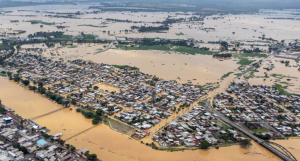 “Rain-triggered floods ravage Ecuador.
“An aerial drone photo taken on March 15, 2026 shows a flood-affected area in Babahoyo, Los Rios, Ecuador. According to local authorities, at least 11 people were dead in Ecuador due to the rain-triggered flood and landslides this year.”
https://english.news.cn/20260317/5945b30ac7e44f579a550eb091d67fe5/c.html
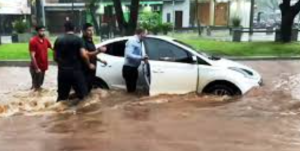 “Floods in the cities of Luque, Mariano, Ñemby, and Ypané [Paraguay]
“Several areas of the Central Department were flooded after today’s heavy rain. The city of Luque was the hardest hit, with its streets and hundreds of homes inundated.”
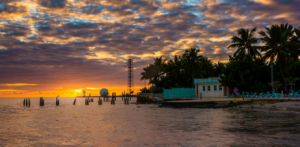 “Exceptional Minimum of 79F [26.1F] in Key West, Florida.
“It ties its Highest Minimum temperature ever recorded in March for the 2nd time this Month. A hot night Typical of August.”
https://x.com/extremetemps/status/2033228615790539247
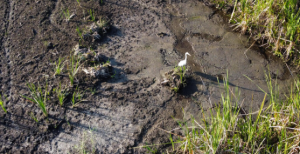 “‘Dry to the bone’: Drought squeezes Everglades airboat operators.
“For the first time in the 30 years since Tigertail Airboat opened, the company is running tours out of the canal because of the extreme drought. Dryness levels in the Everglades are about a month ahead of schedule.”
https://www.miamiherald.com/news/local/environment/climate-change/article314912823.html
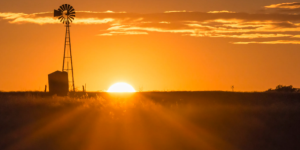 “Brutal heat in TEXAS 105F [40.5C].
“As forecast today Texas was exceptionally hot: a very few times in history USA rose to 105F within mid March (one was last month); New monthly record at Edinburg with 102F; Mc Allen with 104F missed it by 1F. This is nothing vs the heat coming in the West.“
https://x.com/extremetemps/status/2033368895277629693
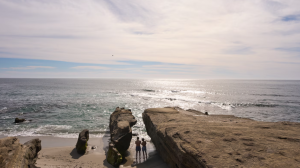 “Millions of people in the western US are preparing for extreme heat as unprecedented temperatures are forecast across California, Nevada and Arizona…
“Heat warnings are in effect across region… the first time in history that such a warning has been issued in March for the region, as temperatures are upwards of 20F to 30F above average.”
https://www.theguardian.com/us-news/2026/mar/16/west-coast-extreme-heatwave
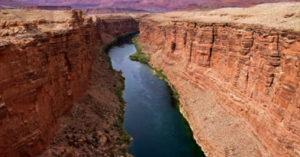 “The Colorado River’s Problems Are About to Get Deeper.
“A heat wave will quickly melt what little snow there is, and the states along the river are struggling to agree on how to divvy up the dwindling resource, with the federal government potentially stepping in.”
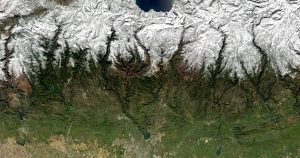 “Record March heat could melt Sierra snowpack 5 weeks early, scientists warn.
“The lab says the unusually warm weather will significantly accelerate snowmelt, potentially causing the Sierra snowpack near Donner Pass to melt out as early as the first week of April — about five weeks earlier than normal.”
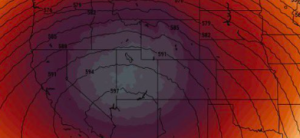 “This is so absurd. This model run has the Western US heatwave peaking just shy of a 600DM ridge.
“That’s about the strongest ridge that the region has ever seen even in the middle of summer. This is not normal.” [Spike Davis]
https://x.com/AZStormChase/status/2032957541445947897
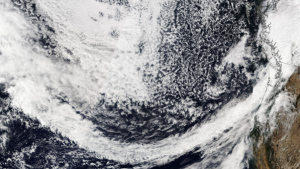 “Vancouver Braces as Powerful Atmospheric River Looms.
“Vancouver and the broader South Coast of British Columbia are preparing for a powerful atmospheric river expected to bring intense rainfall, rapid snowmelt and a heightened risk of flooding and landslides…”
https://www.thetraveler.org/vancouver-braces-as-powerful-atmospheric-river-looms/
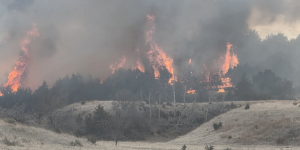 “Biggest wildfire in Nebraska history continues to burn out of control.
“Three major wildfires, including the largest one in Nebraska history, have burned around 600,000 acres of land in central and western Nebraska and remained 0% contained on Sunday after killing one person, officials said.”
https://abcnews.com/US/biggest-wildfire-nebraska-history-continues-burn-control/story?id=131086196
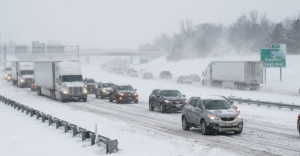 “Historic Blizzard Conditions Blast Michigan’s Upper Peninsula, Midwest.
“A life-threatening situation is unfolding as a monstrous blizzard is unleashing feet of snow and vicious wind gusts throughout the Upper Midwest and Great Lakes. More than 2 feet of snow has fallen in Wisconsin and Michigan since Sunday, with potentially historic accumulations expected in the Upper Peninsula.”
https://www.youtube.com/watch?v=IJZ2aCtV6Ws
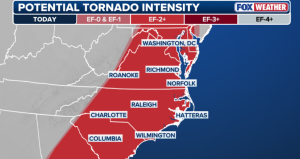 “A rare tornado threat covers Mid-Atlantic, including D.C. area…
“Several rounds of storms are expected in areas at risk. There have been dozens of reports of wind damage from storms Monday morning, so far focused on the western half of North Carolina. Severe weather has also threatened the D.C. area, including a tornado warning…”
https://www.washingtonpost.com/weather/2026/03/16/tornadoes-midatlantic-storms-forecast-risks/
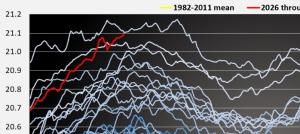 “The mean date for the Winter/Spring peak sea surface temperature is March 20th. Temperatures are still rising.
“Will a new record be set? Stay tuned!” [Prof Eliot Jacobson]
https://x.com/EliotJacobson/status/2033197978492780887
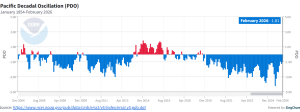 “Will the Pacific Decadal Oscillation turn positive this year?
“If the PDO has been hiding the real forced Earth’s Energy Imbalance and global warming rate during the past 6 years, we could see much faster warming than almost anyone expects.” [Leon Simons]
https://x.com/LeonSimons8/status/2033608781129498990
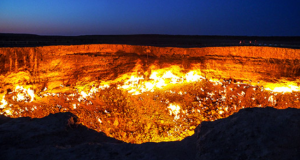 “Revealed: the world’s worst mega-leaks of methane driving global heating…
“The mega-leaks occur across the world, but the top 25 list, produced by the Stop Methane Project at the University of California, Los Angeles (UCLA), is dominated by facilities in Turkmenistan. The scale of methane leaks in the secretive and authoritarian state has previously been described as “mind-boggling”.”
 “An Invisible Crisis: The Hidden Environmental Impact of Pharmaceutical Waste.
“Modern medicine has transformed global health, but its environmental footprint is often overlooked. Around the world, traces of pharmaceuticals are increasingly being detected in waterbodies including rivers, lakes, and groundwater, revealing a growing but hidden form of pollution.”
https://earth.org/an-invisible-crisis-the-hidden-environmental-impact-of-pharmaceutical-waste/
 “The Plastic Detox review – a film so terrifying you will want to change your life immediately…
“The list of ways in which humanity is committing species suicide may be long and growing, but The Plastic Detox is here to suggest that room should be found for the overwhelmingly widespread use of petrochemical-derived plastics.”
I rely on donations and tips from my readers to keep the site running. Every little bit helps. Can you chip in even a dollar? Buy me a coffee or become a Patreon supporter. A huge thank you to those who do subscribe or donate.
You can read the previous “Climate” thread here. I’ll be back tomorrow with an “Economic” thread.

From Pans links above: A rare tornado threat covers Mid-Atlantic, so far focused on the western half of North Carolina…
I think Cassandra is somewhere in the Carolinas, I hope all is well.
Our USA based friends may find this site interesting, it shows daily storm reports:
https://www.spc.noaa.gov/climo/reports/260316_rpts.html
It’s a NOAA website so use it while you can, their budget keeps getting cut. Meh…
Thanks, Flippr. Looks like one touched down in the Charlotte NC area several hours east of me. Where I am we did have big thunderstorms and wind Sunday night and I lost power for 13 hours yesterday. Fortunately we don’t get tornadoes around here very often. A tornado dropped a tree on the first car I ever bought one day after I bought it back in the 1980s when I lived in Minneapolis. Scary stuff.
Yikes! That sounds like a really bad hair day!
Is that the one that mauled the HarMar Mall?
I spent months in Roseville (Rosedale?) in Comten computer training.
That’s where I saw my first lunar eclipse.
Jeez, Cassandra. I hope the insurance company didn’t find a way to weasel out of that one.
I don’t know if it was that one, Rob. Nice memories for you of the eclipse.
Pan, the insurance company paid out without a problem, thank god!!
Yesterday it went from 60 F in the morning to 30 F and snowing by 5 PM. Now it’s 21 F and I’m not shoveling. Hear me?! I’m not shoveling any more!!
Ahh, you know you love it really, John. The crisp air, the satisfying scrape of shovel against frozen concrete – what better way to start the day… 😆
Quark’s latest is titled “Analysis of a crash in the bond and stock markets”
Direct link: https://tinyurl.com/y78jubkz
Google translated, copied and pasted, eight images/graphs missing:
The tension is palpable: oil prices have surpassed $100 per barrel of Brent crude, and diesel has just exceeded $5 per gallon in the US . Therefore, the period of contained inflation appears to be over, and we are entering a new cycle of price increases, similar to the situation in the 1970s .
Naturally, there are differences. Debt in the 1970s was very low, compared to current levels, where debt exceeds almost anything seen before.
Bond markets are beginning to experience significant strain, and today I will focus on two cases that warn of the possibility of an imminent crash if certain resistance levels are breached.
1st). Great Britain.
The 10-year bond presents this aspect.
Since the end of 2022, it has been forming a triangular pattern, with its base repeatedly resting on the 4.8% level. Everything points to a break above that level (5%) followed by a rapid rise towards 7%.
The problem with these movements is the large number of positions that are triggered when certain levels are exceeded. Collateral is used to hedge against risks, and if this collateral experiences a sharp drop in price (remember that price and yield move in opposite directions; a rise in yield means a fall in the bond price), it must be executed to fulfill the insurance, causing a chain reaction of selling. When a level has held for a long time and is broken, automatic selling triggers rapid movements.
As we have seen since the beginning of the conflict in Iran, bond yields have skyrocketed because investors fear inflation resulting from rising oil prices.
The example for the UK 10-year bond, since the attack began (February 28, 2026). It has gone from 4.23% on February 27 to 4.84% on March 13.
I don’t think any further explanation is needed regarding the risk of a break in this resistance zone.
2nd) Japan.
It’s a very complex example.
First, let’s see how the 10-year bond is performing .
I’ve gone back quite a few years here, because the situation is very dangerous. It has broken through the 2% control zones established between 1998 and 2006 and is now in free climb.
The only thing that has slowed its rise has been an agreement, not communicated to the market, to defend certain limits and avoid exceeding them.
In the short term, in January 2026, an intervention was made to contain the rise when it had reached 2.35%.
The problem is that Japan is very big.
The carry trade policy, long practiced by Japanese investors, consisted of borrowing money in yen, taking advantage of its low interest rates, and investing in foreign assets such as US bonds.
The recent rise in Japanese market yields is testing the limits of carry trades and the repatriation of funds to invest in the Japanese market, which is moving toward yields similar to the rest of the Western world. The repercussions of this process are obvious, as it would trigger large sales of other bonds, generating significant losses and increased yields in the rest of the world.
In addition to this dangerous move, Japan must keep a close eye on the yen’s exchange rate, which is also threatening to collapse.
Once again, we have to look at the long term to see where it stands.
Yes, it’s struggling with the 1990 highs around 160 yen per dollar. A break above this level would send the yen plummeting…
The rest of the bond markets have experienced similar movements to those in Great Britain since the end of February, highlighting fears of inflation caused by high oil prices.
After many years of suppressed interest rates, a sustained rise with high profitability would devastate public finances, whose debt is at historic highs.
That is why, as I have discussed in the phases of the crisis , the expected intervention of central banks is to curb this explosive (and disastrous) upward movement in debt yields.
In the case of the stock markets, the situation is much better. The markets remain in bubble mode, seemingly unaware of the problems that lie ahead (for example, such high increases in oil prices usually depress consumption and raise interest rates, which implies lower profits across the board for almost all companies, something that is certainly not priced in by the markets).
But the graphic formations are starting to raise some doubts.
For example, the SP500 .
It appears to be forming a rounded top. A break above 6,500 would trigger a rapid decline.
The fundamentals do not yet reflect the impact of the Hormuz closure, so we will have to wait to see how it is reflected in companies’ earnings reports. A decline in consumption would be typical given the expected interest rate hikes in the coming months, and the stock market usually anticipates bad news.
The crash would only come from overvalued markets, as some valuation models indicate . It’s usually a disastrous combination: bubble stock markets and spectacular rises in oil prices.
The most worrying thing is certainly the rise in oil prices, because it triggers everything else, so we must pay close attention to what happens in the next month.
No one knows what will happen tomorrow, but certainly, if the price of oil exceeds $150-$200, a recession is inevitable, and the consequences for the markets haven’t yet been reflected in their prices, which is usually painful in a crash with a rapid correction. So far, central bank “protection” against any crisis has worked to eliminate the risk from the equation, but it’s unavoidable to process the expected drop in sales following the collapse in consumption. And when starting from bubble-like positions, the declines are amplified rapidly, until central banks decide to intervene again.
We’ll see…
P.S. It’s also possible that the closure of the Strait of Hormuz could end tomorrow and oil prices could never reach $150-200, rendering the entire analysis useless.
That’s why it’s so difficult to make predictions about the future.
All we need to do is monitor the situation in real time to adjust our positions.
Thank you, Flippr.
A quarter of UK bonds are index-linked (ie linked to inflation), so are vulnerable to short-term inflationary shocks. More of our debt is held by overseas investors than Japan, too, again making it more vulnerable to shocks plus, potentially, rapid capital flight.
There have been at least three updates and recalibrations of Limits to Growth. This one came out in 2023. It didn’t make much of a splash in MSM and I don’t know if it made it into C&E (I don’t think I was aware of this site at the time).
https://onlinelibrary.wiley.com/doi/10.1111/jiec.13442
It shows that industrial output and food production should be starting to plunge just about now. The exact peak years may be less notable than the rates of declines with halving in less than 15 years for industry and 20 years for food. Because of human behaviour and random events, such as the Trump’s dementia, the declines will not be smooth, more like a stepwise descent or jagged peaks with large and sudden drops followed by minor and slow recoveries. This year looks certain to see a big fall in industrial output, even without Hormuz it looked probable and may have started a couple of years ago. Similarly with food, with reduced fertiliser and diesel supplies added to a worsening trend of climate related yield declines and possibly a large impact from a super El Nino.
I cannot see a population of around three billion by 2100, even if it is rapidly declining, with virtually no industry and 10% of today’s food.I think less than 200 million all in scavenger tribes that are genetically bottlenecked and declining.
“Because of human behaviour and random events…the declines will not be smooth, more like a stepwise descent or jagged peaks with large and sudden drops followed by minor and slow recoveries.”
George, the study kind of admits the limitations of its own methodology there:
“Another uncertainty is the impact of crises, such as the 2008 financial crisis or the Covid-19 pandemic. These are reflected in the empirical data, for example, the increase in mortality in 2020 or the decrease in IPP in 2008 and 2020. However, LtG as a model is not able to reproduce these short-term events. Rather, it serves to reveal broad trends and dynamics.”
It is probably a blessing we are both unlikely to be around to see the unimaginable dystopia of 2100.
On that last one, couples struggling to conceive in Florida?
Gross.
Gross indeed, for all the reasons I suspect you mean. But also gross in the sense that the endocrine disruptor research of Dr Swan (who is featured in The Plastic Detox) and others, only now finally reaching the mainstream, project that at the rate they document fertility decline, we could hit 0% in 20 years. This recent crop of research publications back a decade or so, and are compelling. I document their studies on the Research page of my climate site barrysmiler.com if that would be of interest. But I also have studies going back to 1961 done by the PFAS manufacturers themselves documenting their dangers. Of course, the manufacturers hid their studies as best they could but eventually researchers like Dr Swan also began looking into such things. And here we are. Definitely gross.
It does sound fascinating but I will probably not be scaring myself with this documentary.
“Alarming amount of microplastics found in prostate cancer tumours… A new study has found microplastics in nine out of 10 prostate cancer tumours as researchers discovered that these tiny particles were present in higher levels inside tumours than in nearby noncancerous tissue.”
https://www.independent.co.uk/news/health/microplastics-prostate-cancer-tumours-b2927891.html
I´m a huge fan of dr. Shanna Swan, but seriously, making a film about how humans extinct themselves via pollution, by helping humans to navigate the pollution so they can add even more humans..:the irony seems to be lost on them.
The few petrochemicals that i have in my appartment are food containers. Like, the most plastic is the food packages we buy everyday and throw away, that´s the shit that ends up in the water, air and food on an unimaginable scale, AAAND medical waste, of course.
Me-need-more-brain, I need to get out of the habit of chewing on a pen lid as I work.
Pan’s posting above: “Indonesia readies 35 cloud-seeding ops amid El Niño threat…
ME: I have no expertise in weather & climatic effects from cloud-seeding, but we should expect the neighboring countries’ ambassadors to greatly protest to Indonesian leaders if their normal weather rainfall suddenly decreases while Indonesia enjoys greater precipitation.
But I could foresee a high probability of military jets shooting down these cloud-seeding planes if Indonesia refuses to recognize their neighbors’ concerns.
Whiskey is for drinking; water is for fighting!
Bob Shaw Are Humans Smarter than Yeast?
Bob, given that cloud-seeding is not all that effective and Indonesia is a mostly remote archipelago, I don’t think it will escalate to that point.
Interesting and methodologically well-developed update of the “Limits to Growth” framework that Kaplan refers to. What continues to surprise me is that water remains the forgotten resource. It is rarely addressed explicitly in these kinds of analyses. Instead, it is tucked away in categories such as agriculture, industry, or “other inputs” and pollution—as if it were a derivative rather than an independent factor. Yet in large parts of the world, the opposite is true.
In arid and semi-arid regions, water is not a variable but a hard limit. Energy can be traded, food can be imported, prices can be adjusted. But water is local. It either falls or it doesn’t. It flows or it doesn’t. And in doing so, it determines far more than we tend to acknowledge.
Take the Middle East or large parts of the United States. Energy may appear abundant, but that abundance rests on a fragile foundation. Desalination plants run on fossil fuels. Without energy, no water; without water, no cities, no industry, no agriculture. The system sustains itself, but only as long as both flows continue.
The same applies elsewhere. Agricultural systems depend on irrigation, industry on cooling, energy production on water use. Water is embedded everywhere, yet prioritized nowhere.Perhaps that is precisely why it receives so little attention. It is difficult to model—regional, erratic, seasonal. It does not fit neatly into the smooth curves of global scenarios.
But that is exactly what makes it important.
Because while energy still has a price, water in many places has already reached its limits. And as is often the case in complex systems, the fracture point lies not in what is visible, but in what is assumed. The energy debate revolves around supply and demand. The reality of water is about presence or absence.
That is a very different conversation. And a far less comfortable one.
Hi Zip. Illustrative of your point is the fact that there is no outcry, nor even suggestion, that maybe spending billions to deliver sparkling clean water to millions, so they can use exponentially more of it to sully with their feces and urine than they use to drink.
I don’t know if another method is possible but I do know one won’t be found as long as we simply accept this horrendously wasteful system as necessary.
Brutal El Niño and worst oil crisis literally ever, which will exacerbate the various ongoing water crises around the world, which will in turn exacerbate the oil crisis which will in turn exacerbate a bunch of other crises which will in turn…
Aaaanyway, here’s a relic from simpler, quainter times. An SNL sketch featuring John McCain making fun of his own presidential bid.
Oh late 2000s, I should never have dumped you. PLEASE COME BAAACK!!!
Breaking news from the AP:
———————–
https://apnews.com/live/iran-war-israel-trump-03-17-2026
Live updates: Top US counterterrorism official Joe Kent resigns over Iran war
The director of the National Counterterrorism Center, Joe Kent, has announced his resignation, saying he “cannot in good conscience” back the Trump administration’s war in Iran.
Kent said on social media that Iran “posed no imminent threat to our nation, and it is clear that we started this war due to pressure from Israel and its powerful American lobby.”
—————————————
ME: With an El Nino looming with elevated wet-bulb temps: perhaps Israel is now strongly yearning for the cool, cool Promised Land 2.0 more than ever? The sooner the better?
Snow cones are more fun than shahed drones.
————————————–
https://www.politico.com/news/2026/03/17/they-hold-the-cards-now-trump-allies-fear-iran-is-slipping-beyond-the-presidents-control-00830449
‘They hold the cards now’: Trump allies fear Iran is slipping beyond the president’s control
Trump supporters who backed his promise to avoid new Middle East wars worry Iran’s attacks on shipping are pushing the U.S. toward escalation — and maybe even boots on the ground…
…The concern among some Trump allies is that ensuring the free flow of oil through the Strait of Hormuz could require securing parts of Iran’s shoreline, a step that would almost certainly mean putting American troops on Iranian soil.
“The terms have changed,” said a second person familiar with the U.S. operation in Iran. “The off-ramps don’t work anymore because Iran is driving the asymmetric action.”…
—————————————–
Looks like China has pulled the plug on all fertilizer exports
https://ddgeopolitics.substack.com/p/the-famine-signal-chinas-fertilizer?triedRedirect=true
Nothing to worry about. We probably won’t go extinct in 2026.